Clothesline in Winter

Clothesline in Winter

Thursday, May 16, 2013

The Privilege of Skepticism

Written by Kyle Schaap

Kyle Schaap
If you are reading this and are from North America (and perhaps even if you aren't), you are no doubt aware of just how divisive the issue of climate change is in the US and Canada. Experts from both sides of the issue are regular installments on the 24-hour news networks, presenting the latest data in favor of or disputing the warming of the planet. Policy experts offer the pros and cons of legislation aimed at cutting greenhouse gas emissions. Law makers debate possible action steps. Facebook posts supporting or refuting climate change turn into hotbeds of political (and sometimes a little bit of personal) attacks. Friends bicker; family relationships are strained. 

This is simply the reality of the political climate in North America, but the existence of such rigorous debate is no coincidence. If warming trends continue the way that scientists are currently projecting (4 degrees Celsius by the end of the century), things in North America won't look all that different. We'll probably experience more droughts, our growing zones will shift, and Michigan will have the climate of Tennessee.  Even if things do get bad in North America, we have the money and technology necessary to adapt fairly well to any changes in weather patterns or growing seasons that we might experience. In short: North America can afford not to worry about climate change—at least for a while.

But what will happen to other parts of the world if warming continues at the rate projected? The predictions are staggering: the inundation of coastal cities; increasing risks for food production, potentially leading to higher malnutrition rates; many dry regions becoming dryer, and wet regions wetter; unprecedented heat-waves in many regions, especially in the tropics; substantially exacerbated water scarcity in many regions; increased frequency of high-intensity tropical cyclones; and irreversible loss of biodiversity, including coral reef systems. A recent report commissioned by the World Bank Group identifies some of the most vulnerable cities to be in Mozambique, Madagascar, Mexico, Venezuela, India, Bangladesh, Indonesia, the Philippines and Vietnam. In short: utter catastrophe for much of the Global South.

So how do we explain the existence of such ambivalence in North America toward climate change in the face of such shocking predictions? I believe that part of the answer is that we have the privilege of skepticism. We have been largely shielded from the effects of a warming world. As such, we have the freedom to debate the existence of the climate disruption that scientists are telling us about. "I don't see any substantial changes to weather patterns. Are we sure this is really happening?" 

Something I've been struck by during my time here so far is that a changing climate isn't a debate in Kenya; it is a daily reality. It is a daily reality for the farmers we talked to who can no longer predict the rains and do not know when to plant their crops. It is a daily reality for villagers whose centuries-long river-fed water supplies are dwindling ever lower by the day. 

Increasing severe drought drives a desperate search for water
There is no doubt the debate over climate change will continue to rage in North America for some time to come. Figures will be cited, studies will be pointed to, voices will be raised. As long as we continue to be largely sheltered from the effects of a warming world, doubt will infuse our public discourse. But as we continue to exercise our privilege of skepticism, people in Kenya—and in other vulnerable places around the globe—will continue to pay the price of our ambivalence. Because make no mistake: Inaction costs something. We just aren't the ones that are paying for it.

Kyle Schaap is Policy Analyst/Advocacy Fellow for the Christian Reformed Office of Social Justice. This post originally appeared at World Renew's Volunteer Blog. Kyle recently led a group of Christians to Kenya to witness the impact of climate disruptions on the poor.

Wednesday, May 8, 2013

Cooking Without Fire


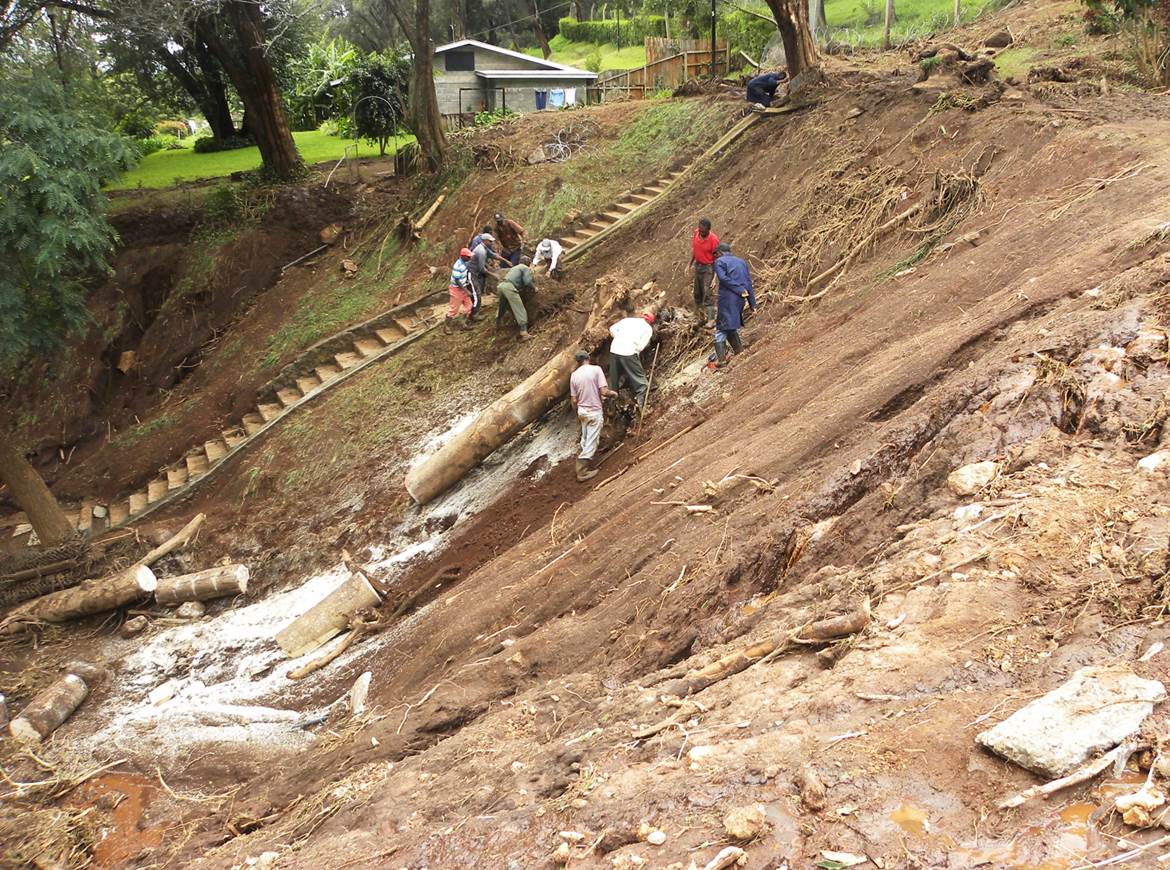
About ten days ago, a massive mudslide swept away three little Kenyan girls in the small town of Kijabe. We arrived in Kijabe only a few days after the flood, to find scores of local people cutting up fallen trees, carting away mud and clearing roadways.

We reported on the Kijabe mudslide a few days ago. Recall that in one month alone, Kijabe has received more rain than its annual average over the last three decades. On the night of the disaster, 5.5 inches more fell in less than two hours. The saturated soils simply could not absorb the torrent, and they gave way in a lethal wall of clay-red African mud.

Kijabe forests couldn't keep mud from swamping the town
It happens that Kijabe is home to one of the best medical centers in East Africa, the AIC Kijabe Hospital. The hospital treats more than 150,000 patients every year, who wind their way up or down the Rift Valley escarpment to Kijabe, perched midway between the clouds and the valley floor. But the narrow roads were rendered impassable by the mudslide, and the hospital’s water source was also cut, its collection tanks now sitting idle and empty.

You may recall our lament at the cruel impact of climate change on this key lifeline for so many vulnerable Kenyans.  But assessing the impact of climate change can be tricky business. Usually climate disruption creates the background condition on which more proximate ills take their toll. The Darfur genocide, for example, may have been predictable by anyone looking seriously at the desertification of the African Sahel, driving migration of largely Islamic nomadic pastoralists in search of water and grasslands into largely Christian farming communities. But the news outlets mainly brought us images of President Omar Al-Bashir’s hordes sweeping down on helpless villagers. What caused the Darfur tragedy? Climate disruption? Ethnic hatred? Or a genocidal ruler? Of course, it’s a false choice.

I’m beginning to see Kijabe’s current predicament that way too. Sure, floods like these have never happened before, and the story of extreme weather is being repeated all over Kenya. But two men on the ground are showing us another story too. Craig Sorley and Jeff Davis live and work in Kijabe, and spend countless hours trying to defend the hillside forests from illegal cutting for the charcoal trade. From a distance, these forests look healthy, but venture inside, and you see a wounded landscape, with many tree stumps and abundant signs of charcoal pits – the handiwork of illegal poachers. It is this depleted forest that released the torrent of mud that wreaked havoc on the town below last week.

Sorley & Davis after Kijabe's mudslide: Was it the rain, or deforestation?
Craig and Jeff do some old-fashioned law enforcement to protect this corner of the creation, tracking down poachers and hauling them before the local magistrates.  But you might be surprised at some of the simpler, sensible things they do to erode the demand for the illegal cutting that now threatens their town. One of my favorites is a simple contraption that you can make at home to cut your own energy use. It’s called the “fireless cooker.”

Davis' fireless cooker
The fireless cooker is little more than a wicker basket, sized to accommodate a cooking pot. The basket is lined with a thickly insulated quilt, and the top is covered with a round pillow, sized to fit inside the basket lid. That’s it. Nothing more. Now, you bring your beans, your rice, your potatoes or stew to a boil on the stove in a lidded cook pot with only short handles, and then plop it into the fireless cooker for the rest of the cooking time. Come back in thirty minutes, and the rice is cooked. Come back in a few hours, and your beans are ready.

It turns out the today’s Kenyan fireless cookers are nothing new. Your great-great grandma knew about these things. She might have called them “hay boxes” – named for their ability to deliver hot food to field workers racing to bring in the hay while the weather held. Others were used by westward travelers who couldn’t take the time to look for firewood at the noon meal.

Our friends in Kijabe swear by it today. So yesterday, I decided to test the idea. I boiled a pot of dried beans in a large saucepan on the stove, and then turned the fire off. In a larger pan, I lined the bottom with a few dish towels, and set the saucepan inside. I then wrapped the whole thing with a small throw-blanket. A couple hours later, I came back to check my “fireless beans.” Completely cooked!

Other styles of cookers; same result
So, Craig and Jeff, I’m planning on joining up by making a real fireless cooker of our own. Who knows, maybe one of our readers will launch a cottage industry to save people millions in energy costs, and spare the earth higher greenhouse gas pollution in the bargain. But in Kijabe, it is one of many sensible initiatives that are coming together to save a threatened forest, and protect the lives of vulnerable Kenyans and forest creatures.

I’d bet you’ve come up with practical ways to care for God’s injured world on your own. Why not share them with us, so we can pass on the good news?

Thanks for reading, and may God bless you.


J. Elwood


More images from Kijabe

Jeff Davis, forest-keeper in spare time

AIC Kijabe Hospital's water tanks: disabled & empty
 
Cooking pot fits nicely inside Davis' fireless cooker

Sorley with one of many replanted saplings
Kijabe people clearing debris from mudslide

Tuesday, May 7, 2013

Give Us This Day Our Daily Toilet


Kibera. The biggest slum in Kenya. Second biggest in all of Africa.

From all over Kenya, they pour into this place, a sprawling community in southeast Nairobi, home to as many as one million living souls. Many come here from family farm plots that have become too small from subdivision; others are driven off the land by failing rains, extreme floods and erratic seasonal patterns; some are the victims of soil depletion from unsustainable farming practices. Whatever the reason, they are here looking for a better life.

Kibera: Last stop in Kenya's urban migration
A better life? It’s hard for me to imagine what a worse life might look like. An uncountable throng in a continuous stream up and down muddy alleys, paths and narrow clay-red streets; unbroken ranks of tin and mud shacks crowding against each other and squeezing into serpentine pathways; vendors selling plastic sandals, maize, charcoal or other essentials at virtually every hut; open cooking fires everywhere; trash mixed with mud and sewage underfoot; and the air above choked with acrid smoke.

And what am I doing here? I’m the only mzungu in sight among thousands and thousands of residents going about their daily routines – my alien skin and gray hair a neon presence amidst an ocean of beautiful African humanity. I am accompanied by Rahab Mbochi, an irrepressibly cheerful spirit, who finds friends at virtually every turn in the winding alleys of mud and waste. And by David Quest, another Kenyan working with a waste-management NGO.  And – of supreme importance – by Jeshua, our giant local guide and keeper, a guarantor of safety for a helpless outsider like me.

Tin and trash: the constants of life in Kibera
Think of the names: Rahab, the redeemed harlot whose progeny includes the one called Savior by Christians; David, the man after God’s heart; Jeshua, the real name of Jesus of Nazareth; and even John, the disciple whom Jesus loved. All winding our way into the heart of the largest – and perhaps foulest – slum in East Africa. Rahab confidently strides out in front. The stranger makes sure he stays within reach of Jeshua.

Did I mention what I’m doing here? Primarily, to visit Peepoople. That’s Pee-poop-le. Pee, as in pee. Poop, you know. Add the last syllable, and I imagine you’ve got something like this:  “The people who have devised a way to help deal with all this filth you live in.”  And it’s brilliant. Let me explain.

Kibera has no sewage disposal system. The huts have no toilets; the roads have no drains. Imagine a city of maybe a million tightly-packed people, all looking desperately for somewhere to go. Of course, they do go. People use a small tin bucket, and dispose of the waste outside, where it finds its way into the grayish-brown rivulets that trickle down every path and alleyway. This isn’t just where we’re walking; this is where the children play. Admittedly, there are a few toilet stations here and there, but they cost five shillings – about six cents U.S. – and money is oh-so-scarce here.

Children and sewage don't mix
And – if you’ve resisted the impulse to stop reading in disgust – there’s another thing: At night, it’s unsafe to step out of the hut. So the waste is collected in plastic bags which get hurled into the black sky – Kibera’s infamous “flying toilets.”

America’s attention was riveted a couple of months ago by the ordeal of a stricken cruise ship whose passengers had to make it a week or so without working toilets. I’m afraid Kibera is like a thousand of those ships, with no port anywhere in sight.

And that’s where Peepoople comes in. They have developed an ingenious solution. It’s a waterproof single-use bag made of a compostable organic material, with a bit of granulated urea inside. The bag – a PeePoo bag – is placed like a liner inside a small plastic pail, which together form a sanitary toilet. After use, the bag is tied off in a tight seal enclosing everything, including soiled tissue, and the urea goes to work destroying the pathogens by which human waste spreads so much disease. The used bags are returned to collection centers, where they are composted to provide fertile garden soils and to grow trees.

PeePoo bag ready to return for composting
And for most of Kibera’s people, the cost isn’t overwhelming. The Peepoo bag costs two shillings. But upon return to the collection station, the user gets a one-shilling refund.  So the overall cost per use is just a little more than a U.S. penny. In the bargain, streams of sewage are reduced, potentially lethal pathogens are destroyed, and fertile soils are developed for local gardens.

Now, solutions to vexing problems are seldom as simple as they sometimes sound. Peepoople is in its infancy. Adoption rates are still low in Kibera. There are five or six collection stations, and Kibera needs hundreds. Composting and pathogen testing is ongoing, before Kenyan authorities will permit compost use in sensitive areas.

But Kibera today is a picture of much of the world tomorrow. We know that climate disruptions are driving a tsunami of human migration, as farming systems stagger under the burden of unseen challenges like today’s extreme weather events. Whether in Karachi, Johannesburg, Dhaka, Bangkok or Los Angeles, cities will have to deal with an influx of migrants struggling to survive and unable to afford basic services like clean, safe sewage systems.

Peepoople's Rahab Mbochi, with Japheth
Hats off to Peepoople, to Rahab, to Jeshua, and to the thousands of Kiberans working to provide basic human services where none exist today. If you’d like to learn more about Peepoople, take a look here. And if you’re ever in the neighborhood of Good Hand Farm, and feeling really adventurous, I’ve bought fifty Peepoo bags, and would be glad to share one with you. If you bring it back after use, it’ll only set you back one Kenyan shilling.

Thanks for reading, and may God bless you.


J. Elwood 

Sunday, April 28, 2013

Hope and Crisis: Climate Losses & Perseverance in Kenya


When we witness the relentless onslaught of extreme weather in Kenya, we’re tempted to wonder about how to hang on to hope. The deck looks impossibly stacked against Kenyans for whom drought, flooding and changing disease and pest vectors are spreading hunger and poverty.

But in the last few days, we’ve seen some examples of amazing resiliency and initiative. Community self-help organizations are terracing hillside fields to conserve water and prevent erosion. They are adopting Farming God’s Way, a gospel-based form of conservation agriculture that enhances soil health and conserves moisture. They are planting indigenous trees in many places to restore ecosystems and resist desertification. They are building remarkable sand dams, which turn seasonally-dry rivers into year-round water sources, and raise the water table.

Where these initiatives are being implemented, parched communities are showing marked improvement. Women walk fewer kilometers to carry water home for their families. Children’s clothes are washed more frequently.  Crops flourish in the shade of the replanted tree canopy. Biodiversity is returning, with a wonderful assortment of birds, lizards and others of God’s creatures. And all this, despite indisputable evidence that the climate is becoming harsher, hotter, and more extreme.

We read Psalm 104 in our morning devotions together, and we think of these Kenyan communities – “You make springs gush forth in the valleys; they flow between the hills; they give drink to every beast of the field; the wild donkeys quench their thirst.” For the moment, our hearts sing.

But then, in a cruel reminder of this harsh new world, we hear the news from our friends – Scott and Jennifer Myhre – in nearby Kijabe. More than five inches of rain the night before last pummeled the surrounding area in only two hours. The road into Kijabe was rendered impassible. The mission hospital and the Rift Valley Academy were cut off. Water supplies were threatened.

Record rains sweep away Kenyan hillsides
And then last night, another 1.5 inches fell. Mudslides again closed the roads. Water supply pipes to the Kijabe Hospital have been destroyed, rendering this vital community lifeline almost useless. Many homes, businesses and schools have been seriously damaged.

And worst of all, three little girls have been killed in the mudslides.

Already this month, Kijabe has had more rain than normally falls in an average year, according to local ecologists who monitor these patterns. The community has planted many trees, but those trees can only do so much to hold the soil in place, in the face of such a torrent. And with the mudslides go valuable topsoil, young trees, this year’s crops, access to the hospital, and yes – three precious little girls.

Let me acknowledge the Christian Reformed Church (CRCNA) in all this. Last year, the Synod adopted the Creation Stewardship Task Force Report. The key findings of your church were these:

  • Climate change is occurring and is very likely due to human activity
  • Human-induced climate change is a moral, ethical, and religious issue
  • Human-induced climate change poses a significant threat to future generations, the poor, and the vulnerable
  • Human-induced climate change, as a global phenomenon, poses a significant challenge to us all
  • Urgent action at the personal, communal, and political levels is required to address climate change.

But you didn’t stop with the science, or with broad ethical statements. You sent your own people to vulnerable communities to see for themselves, and to report back to you. That’s a major reason why we’re here in Kenya, and that’s why we’re sending these messages back to you.

We all hope you’re getting an up-close sense of the harm that our treatment of the earth and its atmosphere are doing to our brothers and sisters in these distant lands – and to God’s countless other beautiful creatures. We hope that it gives rise to a gospel-infused, grace-filled discussion within our North American family. And we pray that many of you will hear the cry that we’re hearing from God’s injured creation – and his precious little Kenyan girls.

Thanks for reading, and may God bless you.


J. Elwood


Thursday, April 25, 2013

A Message to America from Kenya’s Church Leaders


Friends with A Rocha and World Renew (both excellent Christian NGOs) managed to get us an extensive meeting yesterday with top leaders of the Kenyan National Council of Churches. It’s hard to say what a privilege it is to meet with Peter Karanja, General Secretary, and Chris Kamau, Sr. Officer for Social Services. These men are top leaders representing the biggest church denominations in Kenya.

At the end of a wide-ranging discussion about creation care and environmental challenges, one of our fellow North Americans asked our Kenyan hosts: “We want you to be totally candid with us. Please don’t pull any punches. What should we tell our churches back in North America?”

They paused for a brief moment. I had the sense that they were torn between Christian hospitality and the Christian honesty we were asking for. But they chose – I think – the route of candor. I wasn’t taping their narrative, but scribbled in my notebook like mad. Here’s a smattering of what they said:

“We are very concerned, especially about America. They are the most obstinate country when it comes to climate change. We don’t know where it comes from. Maybe it comes from industry money, or maybe people just don’t know about climate change. They are not willing to reduce anything, and they’re not at all willing to finance the cost of adaptation (to climate change in affected poorer countries).

“The message needs to get to the American people. You need to tell your leaders: ‘We are the ones who put you in office. You have a responsibility to reduce your greenhouse gases which are harming the rest of the world.’

“We have these international conferences on climate change. But at the end of the day, the U.S. always comes up with something to make them collapse. We come away with nothing, and no hope. Because Christians are one family, they must be the ones to pressure their governments to act responsibly.

“There are a lot of people who have no idea about the impact of their lifestyles on other people. Long after your life is over, your actions will have consequences on us. Many of them will be harmful consequences.”

I just thought you’d want to know how some of the most senior leaders among your global brothers and sisters feel about you and me. If you’re angry at them, let yourself cool off for a bit, and read this again tomorrow. If you’re still angry, consider this: The average Kenyan emits 0.33 tons of CO2 per year. The average American, on the other hand, emits 19.3 tons. It would take 58 Kenyans to generate as much carbon pollution as one of us. But unlike most of us, they’re suffering exactly the droughts, floods and crop failures that climate science has been projecting.

Are you still mad? If not, then maybe you’ll consider passing your thoughts on to your congressional representative. It’s easy and you can do it here.

Thanks for reading, and may God bless you.


J. Elwood