Clothesline in Winter

Clothesline in Winter
Showing posts with label extreme weather. Show all posts

Thursday, May 16, 2013

The Privilege of Skepticism

Written by Kyle Schaap

Kyle Schaap
If you are reading this and are from North America (and perhaps even if you aren't), you are no doubt aware of just how divisive the issue of climate change is in the US and Canada. Experts from both sides of the issue are regular installments on the 24-hour news networks, presenting the latest data in favor of or disputing the warming of the planet. Policy experts offer the pros and cons of legislation aimed at cutting greenhouse gas emissions. Law makers debate possible action steps. Facebook posts supporting or refuting climate change turn into hotbeds of political (and sometimes a little bit of personal) attacks. Friends bicker; family relationships are strained. 

This is simply the reality of the political climate in North America, but the existence of such rigorous debate is no coincidence. If warming trends continue the way that scientists are currently projecting (4 degrees Celsius by the end of the century), things in North America won't look all that different. We'll probably experience more droughts, our growing zones will shift, and Michigan will have the climate of Tennessee.  Even if things do get bad in North America, we have the money and technology necessary to adapt fairly well to any changes in weather patterns or growing seasons that we might experience. In short: North America can afford not to worry about climate change—at least for a while.

But what will happen to other parts of the world if warming continues at the rate projected? The predictions are staggering: the inundation of coastal cities; increasing risks for food production, potentially leading to higher malnutrition rates; many dry regions becoming dryer, and wet regions wetter; unprecedented heat-waves in many regions, especially in the tropics; substantially exacerbated water scarcity in many regions; increased frequency of high-intensity tropical cyclones; and irreversible loss of biodiversity, including coral reef systems. A recent report commissioned by the World Bank Group identifies some of the most vulnerable cities to be in Mozambique, Madagascar, Mexico, Venezuela, India, Bangladesh, Indonesia, the Philippines and Vietnam. In short: utter catastrophe for much of the Global South.

So how do we explain the existence of such ambivalence in North America toward climate change in the face of such shocking predictions? I believe that part of the answer is that we have the privilege of skepticism. We have been largely shielded from the effects of a warming world. As such, we have the freedom to debate the existence of the climate disruption that scientists are telling us about. "I don't see any substantial changes to weather patterns. Are we sure this is really happening?" 

Something I've been struck by during my time here so far is that a changing climate isn't a debate in Kenya; it is a daily reality. It is a daily reality for the farmers we talked to who can no longer predict the rains and do not know when to plant their crops. It is a daily reality for villagers whose centuries-long river-fed water supplies are dwindling ever lower by the day. 

Increasing severe drought drives a desperate search for water
There is no doubt the debate over climate change will continue to rage in North America for some time to come. Figures will be cited, studies will be pointed to, voices will be raised. As long as we continue to be largely sheltered from the effects of a warming world, doubt will infuse our public discourse. But as we continue to exercise our privilege of skepticism, people in Kenya—and in other vulnerable places around the globe—will continue to pay the price of our ambivalence. Because make no mistake: Inaction costs something. We just aren't the ones that are paying for it.

Kyle Schaap is Policy Analyst/Advocacy Fellow for the Christian Reformed Office of Social Justice. This post originally appeared at World Renew's Volunteer Blog. Kyle recently led a group of Christians to Kenya to witness the impact of climate disruptions on the poor.

Wednesday, May 8, 2013

Cooking Without Fire


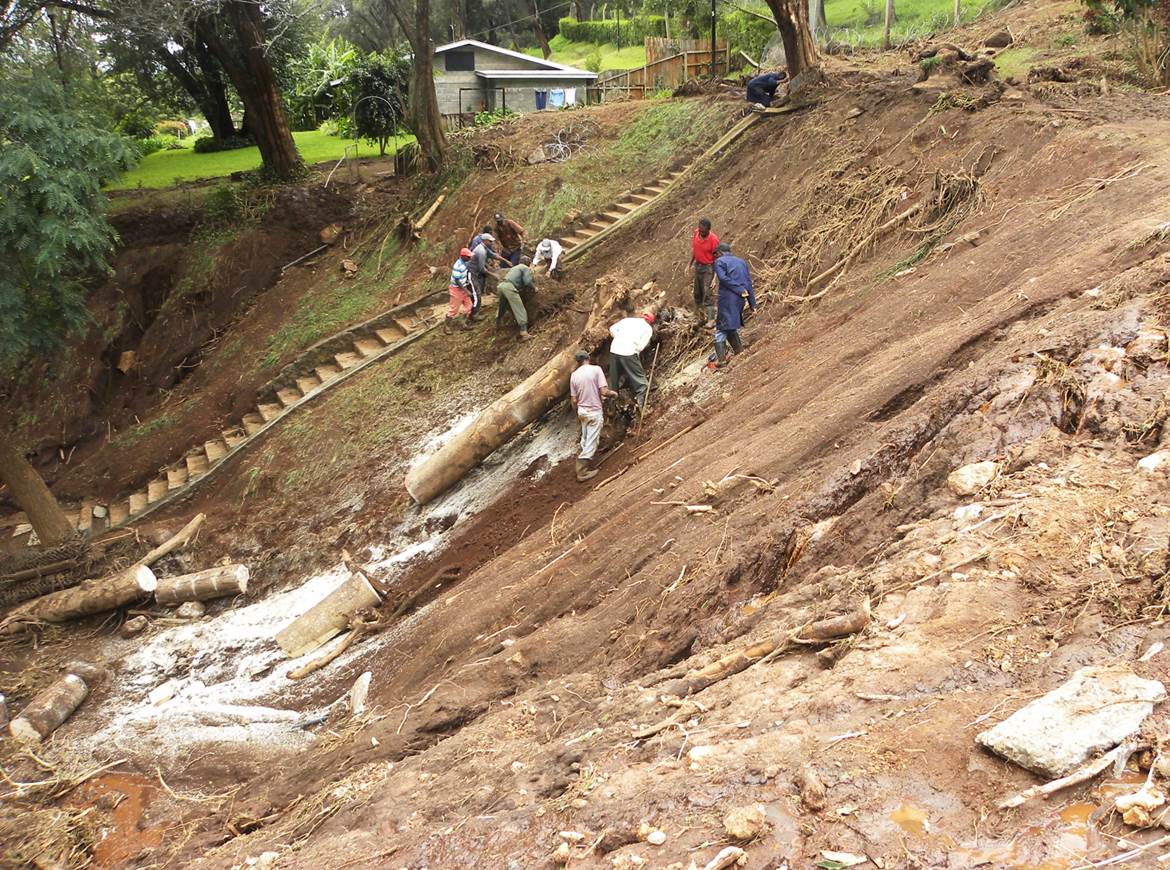
About ten days ago, a massive mudslide swept away three little Kenyan girls in the small town of Kijabe. We arrived in Kijabe only a few days after the flood, to find scores of local people cutting up fallen trees, carting away mud and clearing roadways.

We reported on the Kijabe mudslide a few days ago. Recall that in one month alone, Kijabe has received more rain than its annual average over the last three decades. On the night of the disaster, 5.5 inches more fell in less than two hours. The saturated soils simply could not absorb the torrent, and they gave way in a lethal wall of clay-red African mud.

Kijabe forests couldn't keep mud from swamping the town
It happens that Kijabe is home to one of the best medical centers in East Africa, the AIC Kijabe Hospital. The hospital treats more than 150,000 patients every year, who wind their way up or down the Rift Valley escarpment to Kijabe, perched midway between the clouds and the valley floor. But the narrow roads were rendered impassable by the mudslide, and the hospital’s water source was also cut, its collection tanks now sitting idle and empty.

You may recall our lament at the cruel impact of climate change on this key lifeline for so many vulnerable Kenyans.  But assessing the impact of climate change can be tricky business. Usually climate disruption creates the background condition on which more proximate ills take their toll. The Darfur genocide, for example, may have been predictable by anyone looking seriously at the desertification of the African Sahel, driving migration of largely Islamic nomadic pastoralists in search of water and grasslands into largely Christian farming communities. But the news outlets mainly brought us images of President Omar Al-Bashir’s hordes sweeping down on helpless villagers. What caused the Darfur tragedy? Climate disruption? Ethnic hatred? Or a genocidal ruler? Of course, it’s a false choice.

I’m beginning to see Kijabe’s current predicament that way too. Sure, floods like these have never happened before, and the story of extreme weather is being repeated all over Kenya. But two men on the ground are showing us another story too. Craig Sorley and Jeff Davis live and work in Kijabe, and spend countless hours trying to defend the hillside forests from illegal cutting for the charcoal trade. From a distance, these forests look healthy, but venture inside, and you see a wounded landscape, with many tree stumps and abundant signs of charcoal pits – the handiwork of illegal poachers. It is this depleted forest that released the torrent of mud that wreaked havoc on the town below last week.

Sorley & Davis after Kijabe's mudslide: Was it the rain, or deforestation?
Craig and Jeff do some old-fashioned law enforcement to protect this corner of the creation, tracking down poachers and hauling them before the local magistrates.  But you might be surprised at some of the simpler, sensible things they do to erode the demand for the illegal cutting that now threatens their town. One of my favorites is a simple contraption that you can make at home to cut your own energy use. It’s called the “fireless cooker.”

Davis' fireless cooker
The fireless cooker is little more than a wicker basket, sized to accommodate a cooking pot. The basket is lined with a thickly insulated quilt, and the top is covered with a round pillow, sized to fit inside the basket lid. That’s it. Nothing more. Now, you bring your beans, your rice, your potatoes or stew to a boil on the stove in a lidded cook pot with only short handles, and then plop it into the fireless cooker for the rest of the cooking time. Come back in thirty minutes, and the rice is cooked. Come back in a few hours, and your beans are ready.

It turns out that today’s Kenyan fireless cookers are nothing new. Your great-great grandma knew about these things. She might have called them “hay boxes” – named for their ability to deliver hot food to field workers racing to bring in the hay while the weather held. Others were used by westward travelers who couldn’t take the time to look for firewood at the noon meal.

Our friends in Kijabe swear by it today. So yesterday, I decided to test the idea. I boiled a pot of dried beans in a large saucepan on the stove, and then turned the fire off. In a larger pan, I lined the bottom with a few dish towels, and set the saucepan inside. I then wrapped the whole thing with a small throw-blanket. A couple hours later, I came back to check my “fireless beans.” Completely cooked!

Other styles of cookers; same result
So, Craig and Jeff, I’m planning on joining up by making a real fireless cooker of our own. Who knows, maybe one of our readers will launch a cottage industry to save people millions in energy costs, and spare the earth higher greenhouse gas pollution in the bargain. But in Kijabe, it is one of many sensible initiatives that are coming together to save a threatened forest, and protect the lives of vulnerable Kenyans and forest creatures.

I’d bet you’ve come up with practical ways to care for God’s injured world on your own. Why not share them with us, so we can pass on the good news?

Thanks for reading, and may God bless you.


J. Elwood


More images from Kijabe

Jeff Davis, forest-keeper in spare time

AIC Kijabe Hospital's water tanks: disabled & empty
 
Cooking pot fits nicely inside Davis' fireless cooker

Sorley with one of many replanted saplings
Kijabe people clearing debris from mudslide

Sunday, April 28, 2013

Hope and Crisis: Climate Losses & Perseverance in Kenya


When we witness the relentless onslaught of extreme weather in Kenya, we’re tempted to wonder about how to hang on to hope. The deck looks impossibly stacked against Kenyans for whom drought, flooding and changing disease and pest vectors are spreading hunger and poverty.

But in the last few days, we’ve seen some examples of amazing resiliency and initiative. Community self-help organizations are terracing hillside fields to conserve water and prevent erosion. They are adopting Farming God’s Way, a gospel-based form of conservation agriculture that enhances soil health and conserves moisture. They are planting indigenous trees in many places to restore ecosystems and resist desertification. They are building remarkable sand dams, which turn seasonally-dry rivers into year-round water sources, and raise the water table.

Where these initiatives are being implemented, parched communities are showing marked improvement. Women walk fewer kilometers to carry water home for their families. Children’s clothes are washed more frequently.  Crops flourish in the shade of the replanted tree canopy. Biodiversity is returning, with a wonderful assortment of birds, lizards and others of God’s creatures. And all this, despite indisputable evidence that the climate is becoming harsher, hotter, and more extreme.

We read Psalm 104 in our morning devotions together, and we think of these Kenyan communities – “You make springs gush forth in the valleys; they flow between the hills; they give drink to every beast of the field; the wild donkeys quench their thirst.” For the moment, our hearts sing.

But then, in a cruel reminder of this harsh new world, we hear the news from our friends – Scott and Jennifer Myhre – in nearby Kijabe. More than five inches of rain the night before last pummeled the surrounding area in only two hours. The road into Kijabe was rendered impassible. The mission hospital and the Rift Valley Academy were cut off. Water supplies were threatened.

Record rains sweep away Kenyan hillsides
And then last night, another 1.5 inches fell. Mudslides again closed the roads. Water supply pipes to the Kijabe Hospital have been destroyed, rendering this vital community lifeline almost useless. Many homes, businesses and schools have been seriously damaged.

And worst of all, three little girls have been killed in the mudslides.

Already this month, Kijabe has had more rain than normally falls in an average year, according to local ecologists who monitor these patterns. The community has planted many trees, but those trees can only do so much to hold the soil in place, in the face of such a torrent. And with the mudslides go valuable topsoil, young trees, this year’s crops, access to the hospital, and yes – three precious little girls.

Let me acknowledge the Christian Reformed Church (CRCNA) in all this. Last year, the Synod adopted the Creation Stewardship Task Force Report. The key findings of your church were these:

  • Climate change is occurring and is very likely due to human activity
  • Human-induced climate change is a moral, ethical, and religious issue
  • Human-induced climate change poses a significant threat to future generations, the poor, and the vulnerable
  • Human-induced climate change, as a global phenomenon, poses a significant challenge to us all
  • Urgent action at the personal, communal, and political levels is required to address climate change.

But you didn’t stop with the science, or with broad ethical statements. You sent your own people to vulnerable communities to see for themselves, and to report back to you. That’s a major reason why we’re here in Kenya, and that’s why we’re sending these messages back to you.

We all hope you’re getting an up-close sense of the harm that our treatment of the earth and its atmosphere are doing to our brothers and sisters in these distant lands – and to God’s countless other beautiful creatures. We hope that it gives rise to a gospel-infused, grace-filled discussion within our North American family. And we pray that many of you will hear the cry that we’re hearing from God’s injured creation – and his precious little Kenyan girls.

Thanks for reading, and may God bless you.


J. Elwood


Monday, January 21, 2013

Climate Chaos on Martin Luther King’s Day


Today, we celebrate the life and legacy of Martin Luther King, Jr.


King, the great Baptist pastor who led the Civil Rights movement when I was a child; King, who peaceably organized the Montgomery Bus Boycott against entrenched racism; King, who thrilled and inspired a generation with his “Dream” speech on the steps of the Lincoln Memorial; King whose government subjected him to FBI surveillance and harassment as a subversive for much of his life; and King, who finally laid down his life in the path of an assassin’s bullet, following his master in sacrifice for others.


Today, there’s a beautiful monument in memory of Dr. King along the Tidal Basin in Washington. It’s one of my very favorite places. Just last week, Barbara and I had the chance to visit it once more. We walked in silence along the granite wall inscribed with his writings and speeches. We spoke very little, as we took in the beauty and gravity of this great soul:

  • "Darkness cannot drive out darkness, only light can do that. Hate cannot drive out hate, only love can do that."
  • "If we are to have peace on earth, our loyalties must become ecumenical rather than sectional. Our loyalties must transcend our race, our tribe, our class, and our nation; and this means we must develop a world perspective."
  • "We are caught in an inescapable network of mutuality, tied in a single garment of destiny. Whatever affects one directly, affects all indirectly."
  • "The ultimate measure of a man is not where he stands in moments of comfort and convenience, but where he stands at times of challenge and controversy."

January forsythia at MLK Memorial

We had a long drive ahead of us, so after our brief rendezvous with greatness, we hurried between the massive granite blocks toward our waiting car. But on the plaza leading from the monument, we were confronted with a sight that stopped us cold. The plaza was lined with forsythia bushes, those showy, sprawling yellow shrubs that brightly announce the arrival of spring. They bloom in Washington around March 15th. But there they were, bright and yellow, less than two weeks after the New Year, announcing something much more sinister: the ongoing saga of climate chaos.


The same day, Russians were enduring a freak winter storm, beyond the memories of even the most frost-hardened Muscovites. 12,000 snow removal trucks vainly plied the streets of Moscow, but traffic hardly moved for days.  The MKAD, Moscow’s major traffic artery, was jammed for 13 kilometers going nowhere. And this followed a coldest-ever December for Russia, with temperatures falling to 58 degrees below zero Fahrenheit.


So it looks like 2013 is beginning much like 2012 and 2011, both of which brought us records of extreme weather, drought, wildfires, flooding, rising food prices and hunger across the globe.


And this brings me back to Dr. King. He knew that – despite crushing setbacks – time was ultimately on the side of justice. “No lie can live forever,” he said. “We shall overcome because the arc of the moral universe is long but it bends towards justice.”


Moscow freak storm: Signs of what's ahead
But time is almost certainly not on the side of those who struggle to protect the creation from climate chaos. As we pass tipping point after tipping point, there are fewer and fewer hopes of returning to the world into which we were born, a world capable of sustaining its billions of human souls and more than a million living species.


But perhaps this will be the year our nation rises to meet the challenge of a climate system on steroids. If so, it will happen because we demanded that our leaders take action. Maybe this would be the time for you to make your voice heard. Why not start the year by telling your congressional representatives how you feel? It’s easier than you probably think. Take a moment, click here, and let them know what you’re thinking.


“Not only will we have to repent for the sins of bad people,” wrote Dr. King, “but we also will have to repent for the appalling silence of good people.”

Thanks for reading, and for speaking out, good people. And may God bless you.

J. Elwood