Clothesline in Winter

Clothesline in Winter
Showing posts with label coastal flooding. Show all posts

Friday, December 7, 2012

Hurricane Sandy Response: We Will Rebuild!


Nobody likes a coward. We want our leaders to be resolute when we’re threatened.
   
We think of the classic example, when all seemed lost after Dunkirk in 1940. Who would not have been stirred by Churchill’s defiance?  “We shall defend our Island, whatever the cost may be. We shall fight on the beaches, we shall fight on the landing grounds, we shall fight in the fields and in the streets, we shall fight in the hills; we shall never surrender….”

And in the same vein, who can blame the governors of New York and New Jersey for their bravado after the devastation of Hurricane Sandy?

"Working together,” said New York’s Andrew Cuomo, “we will rebuild stronger and better than ever before, so New York is better prepared and has the infrastructure in place to handle future major weather incidents."

In New Jersey, Chris Christie was no less optimistic: "I'm confident we can rebuild, that we will rebuild, and we'll rebuild together."

Not surprisingly, both governors’ approval ratings have soared. Never surrender; never retreat. We love this stuff.

Court Square Station in Queens as flooding started
But Wednesday evening, I squeezed into a packed hall at NYU to listen to some of New York’s leading experts – climate scientists, meteorologists, sociologists, public health experts and more – reflect on city planning in the post-Sandy era. They all agreed on one thing: When sea levels are rising, only fools refuse to retreat.

Among the experts was Klaus Jacob, a geophysicist with a 40-year career at Columbia University, and a leading New York City advisor regarding the impacts of climate change.  For the last decade, Jacob has warned anyone willing to listen about New York’s vulnerability to climate change.  In 2011, he predicted in a major New York state report that a “100-year storm” – almost exactly what Sandy turned out to be – would flood the subway system in about forty minutes; all major tunnels would be flooded in about an hour; and costs would total about $58 billion.

It’s uncanny how accurate Jacob’s 2011 report was.  Early estimates have put the bill for Sandy at $52 billion, and the number is climbing.
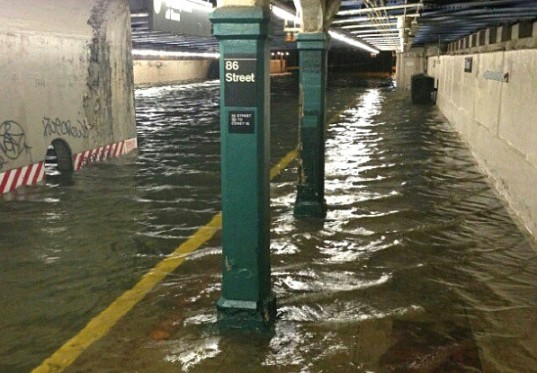
86th Street Station in Manhattan
But Dr. Jacob has a much more sober warning for us. “100-year storms” hit us infrequently; in any year, there’s about a 1% chance that one will strike. On average, that’s one per century, let’s say. But add 2-4 feet of sea level rise, which Jacob and New York’s ClimAID researchers are projecting this century, and the same flooding will occur every 3 to 10 years, he told the NYU audience Wednesday evening.

“You can’t have the whole system being shut down once a decade,” said Jacob a year ago. “What’s important is that we’re vulnerable right now to the 100-year storm. After 40 minutes of rain the entire subway system could be underwater.”

You heard that right. Before we ever heard of Sandy, Jacob was predicting that sea-level rise will give us one of these events every decade on the high side. On the low side? One Sandy-like flood every three years.

Seaside Heights, NJ after Hurricane Sandy
Now, a year ago, some of us would have said Jacob was simply making scientific projections, an exercise often ridiculed by climate skeptics. Hurricane Irene had hit us pretty hard. Many people thought it might be related to climate change. But the climate discussion was still hostage to our national game of political football, and few people really listened. After Hurricane Sandy, NPR host Steve Curwood asked him in a radio interview if this was finally the wake-up call the city – and the country – needed to begin to seriously plan for the ravages of climate change.

“Last year’s [Hurricane] Irene should have been the wake-up call,” answered Jacob. “And then we should have gotten into action. So this is the second wake-up call… how many wake-up calls do we need?”

So let’s say we’ve wakened up. What should we do? I have one suggestion for starters: Before we join the cheering section for the rebuilding of communities in the path of the rising seas, let’s acknowledge that we are fundamentally changing the earth, for ourselves and for distant – and comparatively innocent – people. You may be able to imagine Fortress New York. But no one’s seriously talking about Fortress Bangladesh.

Building seawalls around our threatened cities is probably unwise. But continuing on our carbon binge from inside climate fortresses raises fundamental questions of justice for anyone attuned to the call to care for God’s creation, and for his most vulnerable children.

If you’d like to make your voice about creation care heard in Congress, feel free to copy and edit this letter, and send it to your congressional representatives by clicking here.  And consider adding one message: Please don’t lure people back into harm’s way by promising to rebuild in places from which we should be thoughtfully retreating.

Thanks for reading, and may God bless you.

J. Elwood

Saturday, September 8, 2012

National Flood Insurance: A Good Idea Gone Bad?


Last week, Gulf Coast residents nervously eyed the approach of Hurricane Isaac. Would it again devastate hapless Port au Prince? Thank God, no. Would it inundate the defenseless Florida Keys? Not strong enough, at that point. What about the Republicans in Tampa? They sighed with relief as the storm directed its sights elsewhere – toward New Orleans and the Delta region.

In bayou country, shrimp trawlers dashed up-river, oil workers shut down offshore platforms, and homeowners nailed up plywood.  Meanwhile, the storm crept slowly north through the warm Gulf waters, gathering massive amounts of moisture and increasing in power.

Outside the levees, Isaac flooded many communities
In the end, however, Isaac never gained the strength of a killer hurricane. But it was massive in scale, a slow-moving deluge that wreaked damage in the billions of dollars, according to preliminary estimates. Fortunately, many of the damaged structures had flood insurance, so maybe residents won’t be harmed that badly.

Did you ever wonder, however, where that flood insurance comes from, and who pays for it? For the most part, private insurers won’t touch this kind of risk. Instead, it’s provided by the National Flood Insurance Program (NFIP), a division of FEMA, the Federal Emergency Management Agency. There are some good reasons to have the NFIP. Here’s how it got started:

In 1965, a massive hurricane – nicknamed “Billion Dollar Betsy” – struck the Gulf coast, claiming 75 lives and wreaking havoc on tens of thousands of homes. Not since the Galveston killer storm of 1900 had the Gulf been hit so hard, and insurers promptly jacked up their premiums to compensate for the flooding losses. Of course, consumers howled, and Congress listened.  By 1968, they had created the NFIP to provide flood insurance at reasonable rates, and private insurers happily withdrew from the flood risk market. But in the 1960’s, no one in Congress suspected that the weather might be growing more extreme, or that sea levels were beginning to rise.

In many ways, the NFIP reflects what is good about America. Our neighbors – near and far – often need help that can’t be found through private markets or charities.  The National Guard, the Army Corps of Engineers, the Small Business Administration, and FEMA always come alongside charities in helping disaster-stricken communities in times of need. The NFIP added something new to this: It encouraged sound flood preparation on the part of participating communities, and it got flood-plain property owners to contribute premiums to offset some of the costs of disaster relief.

For decades, it seemed to work like a charm.  Flood premiums roughly covered flood claims in most years, with about 5 percent overhead costs – now about $170 million per year – borne by taxpayers. But coastal communities flourished.  Under the protective umbrella of the NFIP, Florida’s beaches beckoned millions of new residents, driving a statewide population growth rate 2.7 times the national average. Mortgage lenders freed up credit for risky coastal development, vacation homes and condos sprung up by the thousands, and property values soared.  And the related Federal flood mitigation standards helped communities minimize flood damage when storms hit. It seemed a small price to pay, in a country committed to helping storm victims anyway.

But then came 2005. Three epic hurricanes – Katrina, Rita and Wilma – roared through the Gulf with devastating effect.  Suddenly, the nearly-solvent NFIP was saddled with $17 billion in excess claims, and no means to pay other than borrowing from the U.S. Treasury. The NFIP’s debt to taxpayers is still outstanding. In fact, at last count it stood at about $19 billion.

Curiously, you don’t hear much from the budget hawks about the flood program. But there are a few small voices beginning to raise the alarm. Here are a few of the core arguments:
  1. The coastal development enabled by the NFIP has been devastating to wetlands and ecologically-sensitive areas.  Much has been written about the value of “ecosystem services” provided by undeveloped coastal zones: runoff water purification, erosion control, weather mitigation and wildlife habitats, among others.  Once the land is developed, these services are generally lost to the greater society that once enjoyed the benefits.
  2. The NFIP actually encourages otherwise unlikely development in highly risky floodplains. Without it, developers and home buyers would have to pay much higher insurance rates. And while it’s easy to criticize insurance companies for overcharging, they’re actually doing what they’re paid to do: set rates based on risks. With the NFIP, our country is actually luring massive development into harm’s way.
  3. Harm is on the way.  The U.S. Climate Change Science Program has warned of likely increases in severity of storms, and the global science community agrees. In addition, sea levels are rising, and the consensus estimate for the balance of the century is another 3 feet, with many little-understood mechanisms adding to the risk that the estimates could change rapidly – in the wrong direction. A leading coastal scientist, Duke University’s Orrin Pilkey, urges us to assume 7 feet of rising seas by 2100.
  4. And all the evidence points to the fact that our institutions will do everything to defend human structures, once they’re built. The cry: “Protect our beaches!” actually means “Protect my condo!” And the resulting seawalls and levees end up destroying the beaches and wetlands. (E.g. As sea levels rise, the ecologically-irreplaceable Everglades will be long gone before sea water overwhelms Miami’s future levees.)
  5. The OECD has named Miami the number one global loser from sea level rise. And just three of our cities – Miami, New York and New Orleans – will suffer $6.6 TRILLION in sea-rise damage this century, according to their forecasts. That’s equal to just less than half the total national debt, in only three cities. Surely, we won’t want the NFIP to send us the bill for all that.
  6. The data isn’t available to make the case with certainty, but there’s reasonable evidence that much of the taxpayer funding for the NFIP and its huge debt subsidizes the richest households at the expense of the rest of us. Clearly, coastal communities have very high household incomes. Property values almost always come down as you move further away from the water. And many of the most exposed properties are vacation homes, resort hotels, and investment condos – hardly the profile of the hurricane victim that came to mind after Billion Dollar Betsey.
Insured homes in Hurricane Irene on Nags Head, NC
And since numbers like $19 billion are often so large as to lose much meaning, what else might we have done with debt that the NFIP has piled up to date by insuring flood plain properties?
  • We could have built a brand new Yankee Stadium for every baseball team in the American League, plus all those in the NL East as well.
  • Or we could have built nuclear plants to power between eight and eighteen million homes.
  • Or we could have doubled the budget of USAID, to provide economic assistance to the world’s neediest countries.

If these warnings are valid, then what should we do now? I wouldn’t encourage us to immediately jump on the fashionable budget-slashing bandwagon, and kill the NFIP tomorrow. This system has been in place for more than forty years, and the consequences can’t be reversed overnight without harming many innocent people. But the longer we wait to act, the greater the eventual harm. Policy makers need to begin a transitional phase immediately. Here are some principles that might guide us:
  1. Over the next decade, NFIP premiums should gradually increase to reflect the full cost of coastal and flood zone risk – to levels that would be supported by private insurers. Catastrophic flooding like in 2005 will indeed happen again, and probably very soon.
  2. Over a very short time, the NFIP should impose a moratorium on policies for new development in zones that will be flooded by a 5-foot rise in global sea levels. No new policies should be issued for development on barrier islands, which by their nature must shift inland if they are to survive at all in rising seas.
  3. Vacation homes should probably be phased out of the NFIP program as soon as is practicable. It’s awfully hard to argue for subsidizing people who can afford a weekend place in the Hamptons, or a condo in South Beach.
  4. After major losses, NFIP should provide incentives for claimants to relocate out of floodplains, rather than rebuild in harm’s way.
  5. Repetitive-loss properties should be carefully examined for exclusion from the program. Water levels are unforgiving. These properties aren’t unlucky; they’re just too close to the rising tides.

As we take prudent measures regarding the consequences of climate change, we must also remember the demands of justice.  To varying degrees, many coastal dwellers are the victims of the greenhouse gases that we’ve all poured into the atmosphere. We’re all going to suffer from our multi-generational carbon binge. But some people are more exposed to its effects than others. We’ve all created this problem. We must act soon to reduce its effects. And in the process, we must treat the most vulnerable with decency.

But we also have to tell each other the truth: The seas are rising; we can hardly expect our country to help us if we refuse to get out of harm’s way.

Thanks for reading, and may God bless you.

J. Elwood