Clothesline in Winter

Clothesline in Winter

Friday, December 7, 2012

Hurricane Sandy Response: We Will Rebuild!


Nobody likes a coward. We want our leaders to be resolute when we’re threatened.
   
We think of the classic example, when all seemed lost after Dunkirk in 1940. Who would not have been stirred by Churchill’s defiance?  “We shall defend our Island, whatever the cost may be. We shall fight on the beaches, we shall fight on the landing grounds, we shall fight in the fields and in the streets, we shall fight in the hills; we shall never surrender….”

And in the same vein, who can blame the governors of New York and New Jersey for their bravado after the devastation of Hurricane Sandy?

"Working together,” said New York’s Andrew Cuomo, “we will rebuild stronger and better than ever before, so New York is better prepared and has the infrastructure in place to handle future major weather incidents."

In New Jersey, Chris Christie was no less optimistic: "I'm confident we can rebuild, that we will rebuild, and we'll rebuild together."

Not surprisingly, both governors’ approval ratings have soared. Never surrender; never retreat. We love this stuff.

Court Square Station in Queens as flooding started
But Wednesday evening, I squeezed into a packed hall at NYU to listen to some of New York’s leading experts – climate scientists, meteorologists, sociologists, public health experts and more – reflect on city planning in the post-Sandy era. They all agreed on one thing: When sea levels are rising, only fools refuse to retreat.

Among the experts was Klaus Jacob, a geophysicist with a 40-year career at Columbia University, and a leading New York City advisor regarding the impacts of climate change.  For the last decade, Jacob has warned anyone willing to listen about New York’s vulnerability to climate change.  In 2011, he predicted in a major New York state report that a “100-year storm” – almost exactly what Sandy turned out to be – would flood the subway system in about forty minutes; all major tunnels would be flooded in about an hour; and costs would total about $58 billion.

It’s uncanny how accurate Jacob’s 2011 report was.  Early estimates have put the bill for Sandy at $52 billion, and the number is climbing.
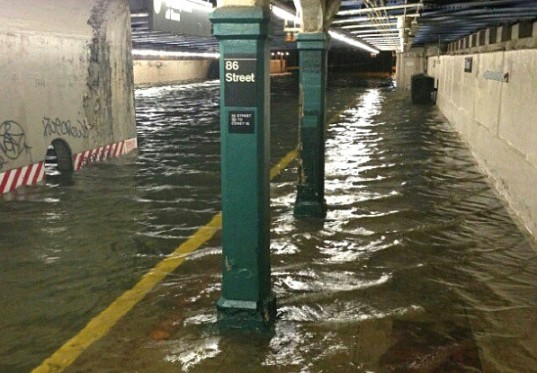
86th Street Station in Manhattan
But Dr. Jacob has a much more sober warning for us. “100-year storms” hit us infrequently; in any year, there’s about a 1% chance that one will strike. On average, that’s one per century, let’s say. But add 2-4 feet of sea level rise, which Jacob and New York’s ClimAID researchers are projecting this century, and the same flooding will occur every 3 to 10 years, he told the NYU audience Wednesday evening.

“You can’t have the whole system being shut down once a decade,” said Jacob a year ago. “What’s important is that we’re vulnerable right now to the 100-year storm. After 40 minutes of rain the entire subway system could be underwater.”

You heard that right. Before we ever heard of Sandy, Jacob was predicting that sea-level rise will give us one of these events every decade on the high side. On the low side? One Sandy-like flood every three years.

Seaside Heights, NJ after Hurricane Sandy
Now, a year ago, some of us would have said Jacob was simply making scientific projections, an exercise often ridiculed by climate skeptics. Hurricane Irene had hit us pretty hard. Many people thought it might be related to climate change. But the climate discussion was still hostage to our national game of political football, and few people really listened. After Hurricane Sandy, NPR host Steve Curwood asked him in a radio interview if this was finally the wake-up call the city – and the country – needed to begin to seriously plan for the ravages of climate change.

“Last year’s [Hurricane] Irene should have been the wake-up call,” answered Jacob. “And then we should have gotten into action. So this is the second wake-up call… how many wake-up calls do we need?”

So let’s say we’ve wakened up. What should we do? I have one suggestion for starters: Before we join the cheering section for the rebuilding of communities in the path of the rising seas, let’s acknowledge that we are fundamentally changing the earth, for ourselves and for distant – and comparatively innocent – people. You may be able to imagine Fortress New York. But no one’s seriously talking about Fortress Bangladesh.

Building seawalls around our threatened cities is probably unwise. But continuing on our carbon binge from inside climate fortresses raises fundamental questions of justice for anyone attuned to the call to care for God’s creation, and for his most vulnerable children.

If you’d like to make your voice about creation care heard in Congress, feel free to copy and edit this letter, and send it to your congressional representatives by clicking here.  And consider adding one message: Please don’t lure people back into harm’s way by promising to rebuild in places from which we should be thoughtfully retreating.

Thanks for reading, and may God bless you.

J. Elwood

Saturday, December 1, 2012

Write to Congress? What Should I Say?

A dear friend read my last post, and followed my suggested link to write her congressman. When she got to the website, she paused:  WHAT SHOULD I SAY??


Good question. You’re concerned about abuse of the creation. You want to protect it for its Maker, for your children, and for all people. But what, specifically should you tell your Senators and Congressperson? As much as you’d like to write your original thoughts, let me suggest you start with something from my pen. Copy and paste it, shorten it, add to it, personalize it as you wish. But at least this will give you a start.

And when you're finished, here's a reminder of how to reach your Congressional representatives: Just click here.


Dear Senator/Representative ________________:

I am writing to urge you to respond to the growing weight of evidence that our present environmental policies are leading to disastrous and unjust results for us, for our children, and for those who are least able to adapt to the damage we are inflicting on the earth. Even though environmental policy has recently become politicized, there is no place for political posturing on issues like the unfolding mass extinction of threatened species, loss of vital habitats and ecosystems, acidification of the oceans, sea level rise, and rapid global climate change. 

Despite controversy that still simmers in Congress, the National Academy of Sciences and virtually all leading scientific associations have made clear the reality of the following dangerous developments:

  • The global climate is rapidly changing due to unparalleled concentrations of greenhouse gases in the atmosphere, resulting in severe droughts, catastrophic flooding, intense tropical storms, and coastal damage;
  • Roughly one-third of all assessed species are threatened with extinction due to habitat destruction and over-exploitation, and climate change is now expected to threaten roughly half of all known species with extinction;
  • Oceans have absorbed much of the carbon we’ve poured into the atmosphere by burning fossil fuels, and are now one-third more acidic than they were a generation ago, imperiling countless marine species and ecosystems on which mankind depends; and
  • Sea levels are rising as oceans warm and ice sheets melt, and are projected to wreak unfathomable damage on the world’s coastal communities, including Miami, New York and New Orleans.

Unless our country acts promptly to protect the earth, our children will inherit a largely unrecognizable planet, beset by famine, displaced populations, altered disease vectors, mass human migration and desperate resource conflicts. In light of these risks, I ask you to take the following steps:

  • Support incentives and research for clean energy and efficiency technologies, such as wind, geothermal, solar energy and efficiency standards. While natural gas is less polluting than coal and has a transitional role in our energy mix, we should not delude ourselves by calling it clean energy.
  • Support global agreements on climate change. The U.S. alone refused to ratify the Kyoto Protocol, and our opposition undermined global efforts to rein in a problem which has now become a global crisis. Global warming is global, and so are its solutions.
  • Eliminate subsidies for polluting fossil fuel industries. Oil, coal and gas are mature industries that do not need – or deserve – taxpayer subsidies. “Energy independence” may sound appealing as a slogan, but with free markets, we can be no more independent than the highest international bidder.
  • Establish a price on carbon emissions. No one has a right to profit from polluting activities, leaving the costs and consequences to our children and those on distant shores. We have successfully limited the emission of ozone-destroying CFCs through market mechanisms, and must do the same with earth-heating greenhouse gases.
  • Defend the EPA from attacks as it acts to protect us from polluters. In particular, support the EPA’s limitations on emissions of heavy metals, sulfur, CO2 and particulates from new and existing power plants.

People who labor to defend the earth lack the lobbying budgets available to polluting industries. But we have a just cause, the vote, and the willingness to take all measures to protect the earth and its most vulnerable children. We look to you as our representative to defend it for all people, both now and in our children's day.

Sincerely,

You've got a voice. Let them hear it!
Don’t forget: It’s easy to reach your Congressional representatives. Just click here.

Thanks for writing, and may God bless you.

J. Elwood


Tuesday, November 27, 2012

Bono and the “Unholy Trio”

Two weeks ago, U2 lead singer Bono paid a visit to a packed auditorium at the World Bank.  In an on-stage conversation with bank president Jim Yong Kim, Bono warned of “an ‘unholy trio’ of extreme poverty, extreme ideology and extreme climate” – which together threaten to stymie global efforts to alleviate poverty and human suffering.

The Irish musician and activist is widely recognized for his advocacy for the poor in Africa. He has been nominated for the Nobel Peace Prize, and was granted honorary knighthood by Queen Elizabeth. And now he’s warning members of one of the world’s leading development organizations about the threat of climate change to the poor of the world.

Before taking the top spot at the World Bank earlier this year, Jim Yong Kim co-founded the global medical NGO Partners in Health with Dr. Paul Farmer, and served as president of Dartmouth College. He added to Bono’s warnings his concern that catastrophic levels of global warming would be reached within the next generation, not in some distant time horizon.

Here are brief snippets from Bono’s comments, and Kim's responses:

Bono:  [An] “unholy trio” of extreme poverty, extreme ideology, and extreme climate make a very difficult weave; very strong, very hard to break. And we have to accept that the climate crisis could undo a lot of the work we do in development.


World Bank president Kim: The world at two or four degrees [Celsius hotter] is going to look so different. And it’s not three generations ahead. I have a three-year-old son. When he’s my age, he could be living in a completely different world. And right now, I don’t see the roots of that movement [to combat climate change] taking shape.

I’m no expert on the World Bank, and I know some people who offer only qualified endorsement of their work.  But when leaders who have dedicated their lives to alleviating poverty raise the alarm about the climate crisis, maybe it’s time for people of goodwill to take action. The world will not do what it must without the United States. And the U.S. will not do what it must while most of our politicians think that we don’t care.

Maybe it’s time we write our representatives and tell them we care. Do it now, by clicking here.

You care. I care. But I'm afraid we have no idea how much our children will wish we had really cared.

May God bless you.

J. Elwood

Friday, November 16, 2012

More Federal Flood Insurance? The Wrong Response to Hurricane Sandy


It’s been almost fifty years since the first billion-dollar hurricane hit American shores. In 1965, “Billion Dollar Betsy” meandered through the Bahamas, changing course like a drunkard, devastating Key Largo, and gathering strength as it headed for landfall at Grand Isle, LA. When was over, 77 people were dead, and costs mounted to $1.42 billion – or $8.5 billion in equivalent current dollars.

Of course, insurance companies reacted to the staggering losses by carving out flood damage from their policies. And Congress responded by creating the National Flood Insurance Program (NFIP) to fill the gap they left behind. For the last 43 years, the Federal government has been the primary provider of flood insurance in the country. And in hindsight, Betsy's losses look like small change, dwarfed by modern monsters like Katrina ($108 billion in losses), Ike ($38 billion) and Wilma ($29 billion).

We’ve written twice about the NFIP: first, about the huge losses that are mounting as taxpayer-subsidized insurance lures ever more people into harm’s way; and second, about states like North Carolina, which have embraced plans to suppress sea-level science, leaving the damage from unchecked coastal development to be paid for by the rest of the country.

When we wrote those posts, we had never heard of Hurricane Sandy. That now seems like a long time ago. Since then, we’ve replaced two roofs and repaired two more at Good Hand Farm; endured two weeks without water, light or heat; and cut up hundreds of tree branches lying on homes and power lines. Few of us imagined that northern cities like New York would be so vulnerable to a “tropical” storm.

Tuckerton, NJ, awash during Sandy storm surge
To be clear, we’ve repeatedly warned our readers – and our personal friends – about the risks of sea-level rise to New York and the Eastern Seaboard. We’ve highlighted the OECD’s projected $2.1 TRILLION cost to New York City, and the surprisingly high toll ahead for the Tidewater region.

But, to be honest, we never imagined it would happen so soon.

When we bemoaned the $19 billion dollars that the NFIP has had to borrow from taxpayers to honor its flood claims, we never imagined that in the span of a few weeks, the number would be hovering at $25 billion. To be fair, no firm numbers are in yet. But the cost of Hurricane Sandy has been estimated at $52.4 billion, and NFIP’s insured losses have been ball-parked at $7 billion. It could be better; or it could be much worse.

Our fiscal-hawk friends will be pounding the table at this point, and who can blame them? $25 billion of taxpayer money has been poured into the sea, mainly to rebuild vacation homes and seaside condos largely owned by wealthier Americans.

But our concern is much more basic: American policy is actively luring our citizens into harm’s way. Many of us have friends who are investing their retirement savings in attractive coastal properties, financed by mortgages that rely on Federal flood insurance. There should be no doubt as to whether these policies will still be available in ten or twenty years. They won’t.

They won’t because sea levels are rising, and coastal storms are gaining intensity – two well-documented consequences of global climate change. Most coastal states are planning on sea-level rise of 1-2 meters this century. Add a meter to Hurricane Sandy’s storm surge, and you have almost inconceivable damage and loss of life. Two meters? It’s beyond counting.

Not just projections: The sea is rising
No Federal program has the money to make good on such losses. For the sake of all Americans living on or near coastal flood zones – and particularly for those considering a move – we simply must remove the enticement to wander into harm’s way. When you’re stuck in a hole – they say – the first rule is this: Stop digging.

So what should we do? Here’s a plan that might serve as a starting point for people smarter than me:

  1. Over the next decade, NFIP premiums should gradually increase to reflect the full cost of coastal and flood zone risk – to levels that would be supported by private insurers.
  2. Over a very short time, the NFIP should impose a moratorium on policies for new development in zones that will be flooded by a 5-foot rise in global sea levels. 
  3. No new policies should be issued for development on barrier islands.
  4. Vacation homes should be phased out of the NFIP program as soon as is practicable.
  5. After major losses, NFIP should provide incentives for claimants to relocate out of floodplains, rather than rebuild in harm’s way.
  6. Repetitive-loss properties should be carefully examined for immediate exclusion from the program.

If there’s any silver lining to the horrors of Hurricane Sandy, it’s that ordinary people have begun to accept that the climate has changed. Perhaps our leaders will now begin to realize that our coastal policies must change with it.

Thanks for reading, and may God bless you.

J. Elwood

Thursday, November 15, 2012

Lausanne Evangelical Movement Calls on Christians to Care for the Earth


The global Christian Lausanne Movement this week issued a Call to Action, declaring care for the creation as a core gospel issue, and calling on all Christians to adopt simpler lifestyles, to radically reduce greenhouse gas emissions, and to mitigate the effects of environmental degradation on the poor. The Call to Action was developed and signed by 57 church leaders, scientists, theologians and creation care practitioners from 26 countries, working in collaboration with the World Evangelical Alliance, whose members represent more than 600 million Christians worldwide.

Individual Christians may now add their endorsement of the Call to Action by clicking here:  http://bit.ly/REMSf7

The
Lausanne Call to Action arose from two fundamental convictions:
  1. Care for the creation is a core element of the gospel, seen in creation, in the resurrection of Christ, and in his mission to reconcile all things to God. As such, it is a necessary element of the Christian response to God’s grace, and would be a core component of Christian life and mission even if the earth were not presently in crisis.
  2. In fact, however, the world is in crisis, brought on by global climate change, deforestation, pollution, loss of species to extinction and water stress. These threats place a heavy burden on the poor, on vital ecosystems and on vulnerable species of animals and plants.

The Lausanne Movement was founded in 1974 by Christian leaders including Billy Graham, John Stott, Francis Schaeffer and Samuel Escobar to reframe Christian mission in a changing world. Represented by leaders from more than 190 countries, Lausanne has worked to apply the gospel to a world gripped by social, political, economic and religious upheaval.

In 2010, the Lausanne Movement convened in Cape Town South Africa, and outlined the Christian responsibility for creation care in the starkest terms: 

We cannot claim to love God while abusing what belongs to Christ by right of creation, redemption and inheritance. We care for the earth and responsibly use its abundant resources, not according to the rationale of the secular world, but for the Lord’s sake. If Jesus is Lord of all the earth, we cannot separate our relationship to Christ from how we act in relation to the earth. For to proclaim the gospel that says ‘Jesus is Lord’ is to proclaim the gospel that includes the earth, since Christ’s Lordship is over all creation. Creation care is a thus a gospel issue within the Lordship of Christ.
 
The new Call to Action, developed by a Lausanne working group assembled in Jamaica this month, filled in the general terms of the Cape Town Commitment with a list of specific measures, including the following:

  • Christians must develop simpler lifestyles, work to restore the creation, and equitably share its bounty with others.
  • The church should develop an integrated theology of creation care to equip pastors in teaching Christians to challenge prevailing economic ideologies which result in harm to the creation.
  • The entire church – including women, children, youth and indigenous people – must mobilize to engage all of society – including governments, businesses and civil society – for creation stewardship.
  • Environmental missions among unreached people should be encouraged as a fully-recognized category of missional outreach, akin to medical missions.
  • The church should engage in radical action to address climate change and reduce greenhouse gases, the harm from which falls most heavily on the poor.
  • The global church should actively promote sustainable food production methods such as conservation agriculture.
  • Churches should encourage small steps to promote local expressions of creation care and preserve local ecosystems.
  • The church must encourage Christian prophetic advocacy to those in power, to mitigate harm to the creation and to support communities devastated by environmental degradation.
  • The church must come to God in prayer, lamentation, repentance, and an appeal to Him to heal the land and all who dwell in it.

Advocating local creation care projects, like nature camps by A Rocha USA
Christians and their leaders from all over the world will be adding their names to the list of signatories. We can do the same, simply by following this link. http://bit.ly/REMSf7 

Won’t you take sixty seconds to stand with your brothers and sisters from around the world in calling for a new commitment to care for our Father’s world, and its most vulnerable children?

Thanks for reading, and may God bless you.

J. Elwood